We are available throughout the Christmas period. Don't hesitate to enquire today.

Under the lamp

Case study

Six Heritage was commissioned by CBRE to undertake a detailed condition survey of the principal façade at 90–100 Market Street, a prominent late Victorian or early Edwardian commercial building within Manchester’s Upper King Street Conservation Area.

Combining close inspection from a mobile elevated work platform with drone photography, the survey established the construction and condition of the façade’s brickwork, sandstone and mortar. It also identified urgent public-safety concerns associated with unstable high-level masonry and provided a practical, conservation-led strategy for repair.

Author

Matthew Amis

Service

Façade condition survey

Completion

March 2026

Client

CBRE

Market Street, Manchester

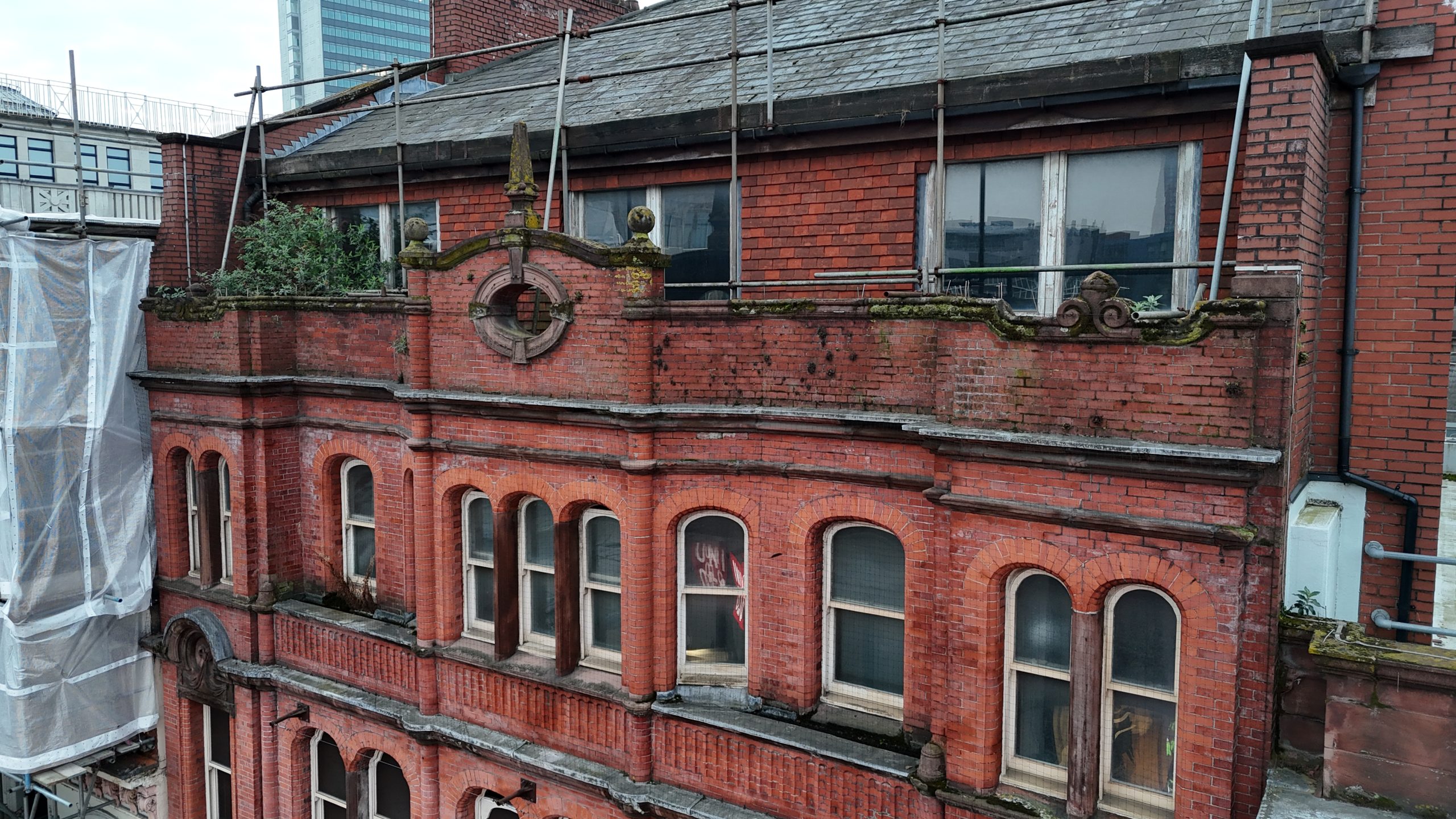
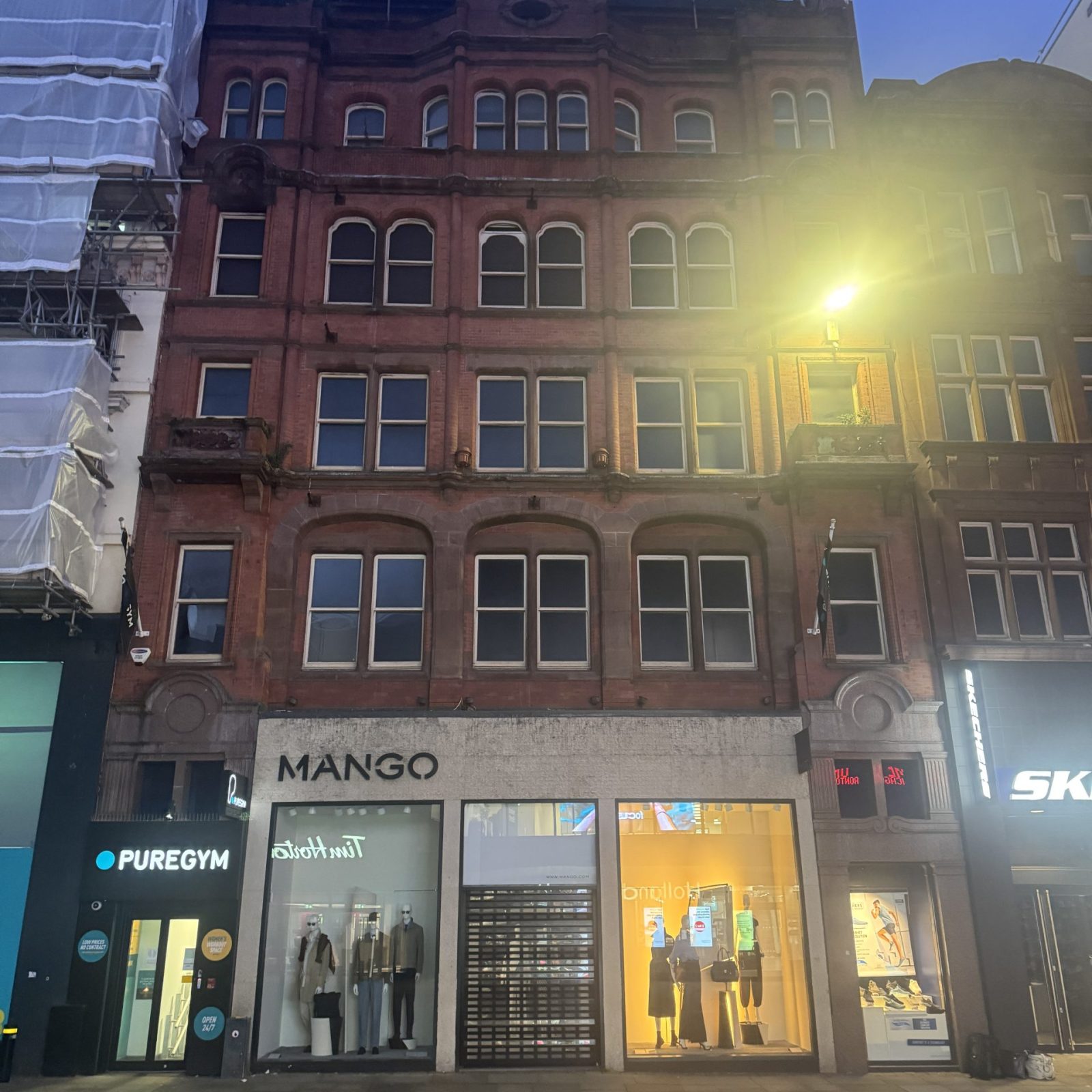
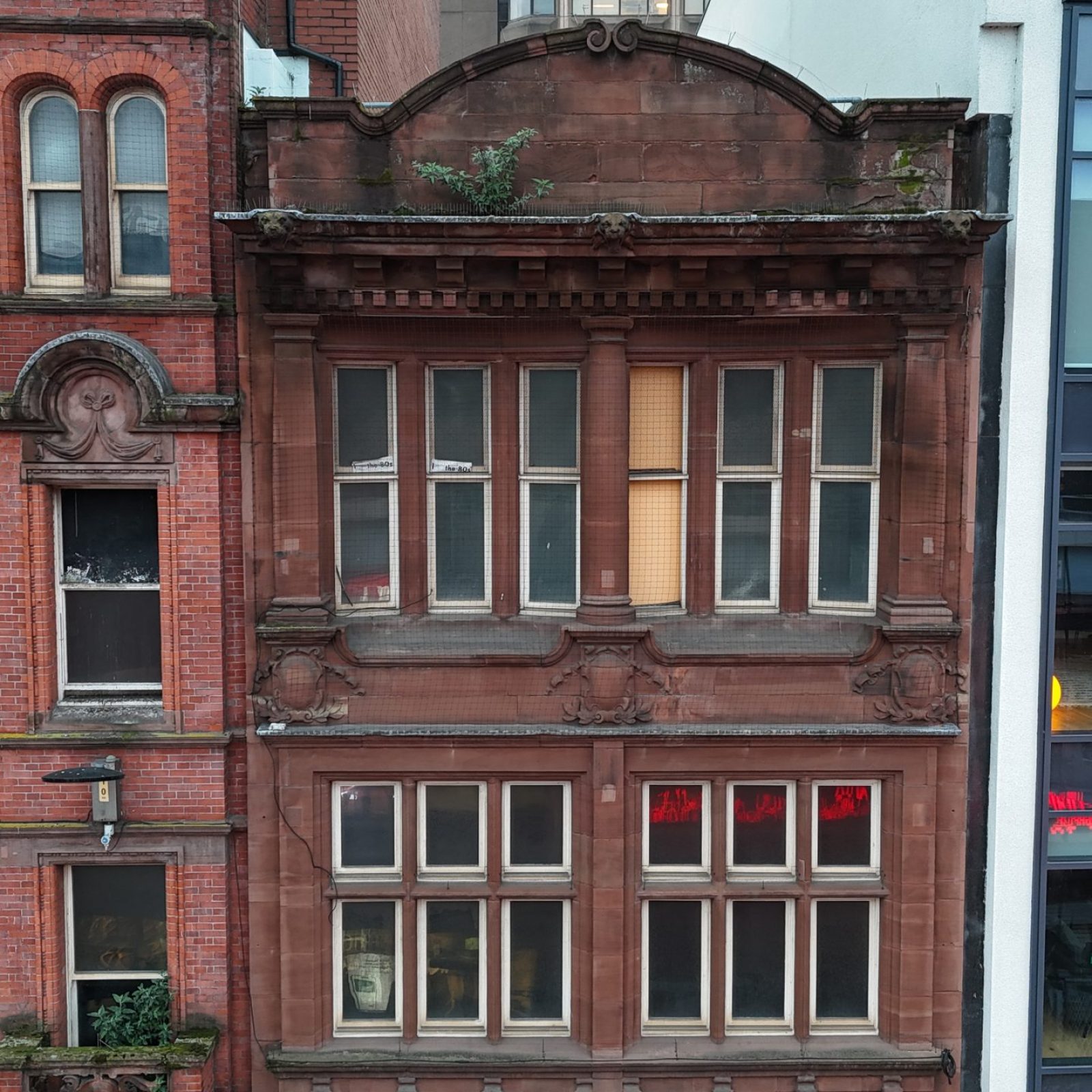
The north-facing elevation is divided into two architecturally distinct sections. The eastern section, above MANGO, is constructed predominantly from red brick with extensive sandstone dressings, while the western section, above SKECHERS, is faced almost entirely in ashlar sandstone.

The brickwork to the eastern section is laid principally in an English Garden Wall bond and incorporates decorative sandstone string courses, cornices, window surrounds, arches and projecting balconies. The western section has a more uniform stone frontage, enriched with moulded details, dentilled courses, crests and other decorative embellishments.

Our investigation focused on the masonry forming these two elevations. Inspection was undertaken from ground level and from a mobile elevated work platform, supported by drone photography of the upper façade, parapets and adjoining roof surfaces. This combination allowed defects that were difficult or impossible to assess from street level to be closely documented.

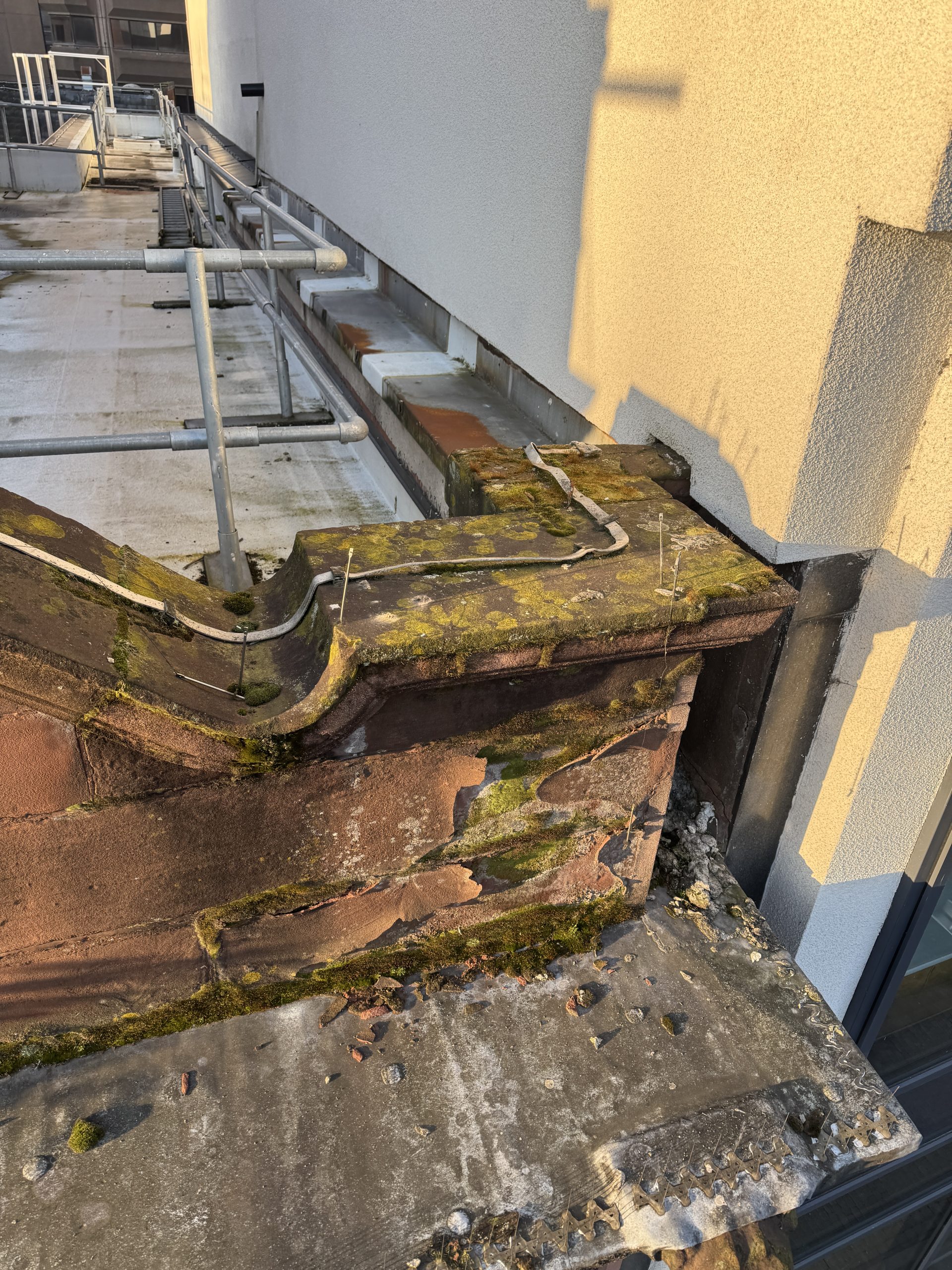
The eastern section was found to be in poor to reasonable condition. Although the principal brickwork remained broadly serviceable, the projecting sandstone elements were significantly more vulnerable. Several cornices and string courses exhibited spalling, delamination and localised material loss, with loose stone remaining at high level despite previous attempts to remove unstable fragments.
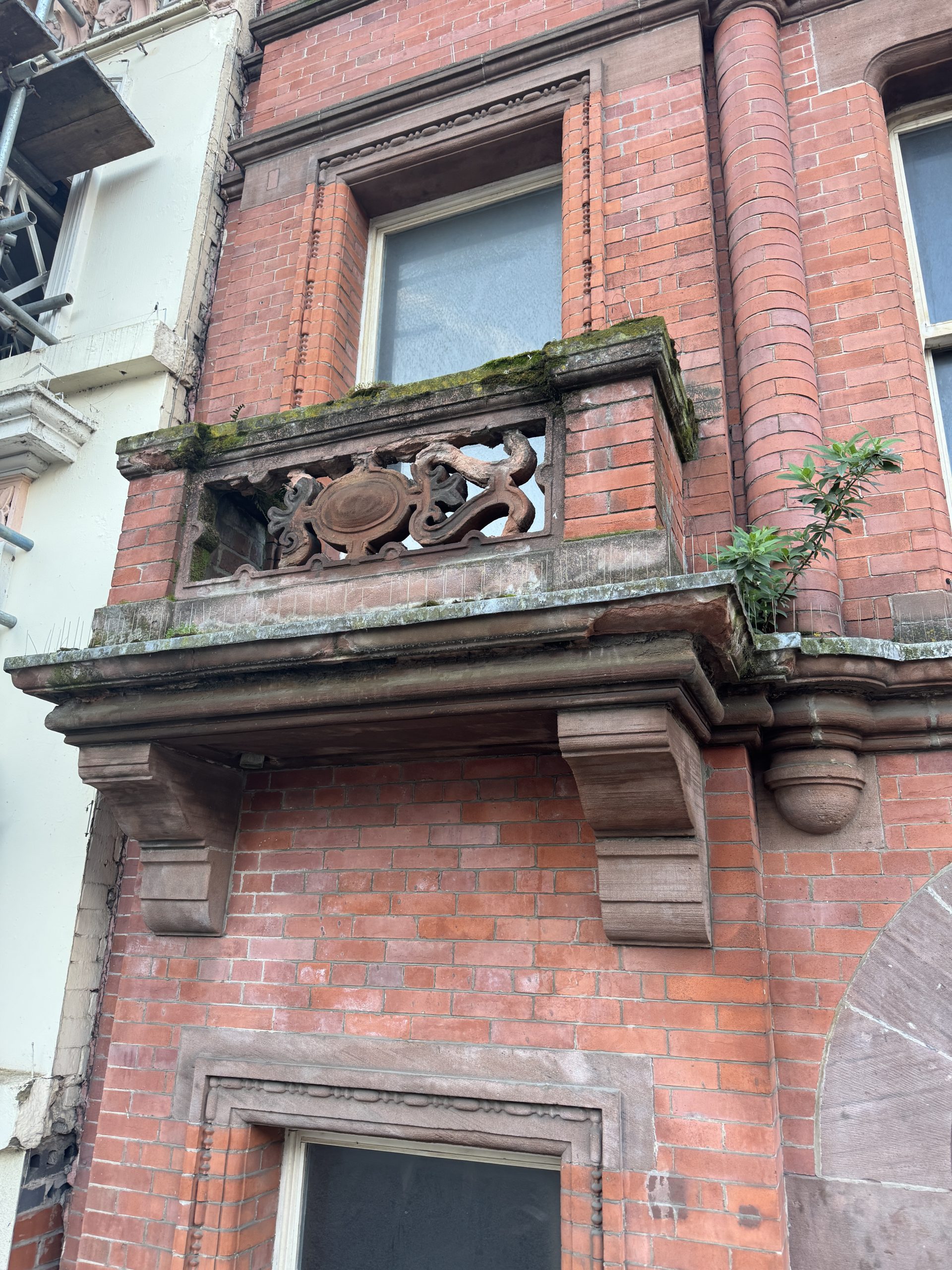
The most serious deterioration was concentrated around the projecting masonry and other areas where water could collect. The two decorative stone balconies were particularly affected, displaying extensive biological growth, accumulated debris, prolonged dampness and the loss of sections of their stone balustrades.

Existing drainage from these balconies appeared to have been removed or altered. The resulting retention of moisture had accelerated decay within the relatively soft and porous sandstone. The condition of the remaining balcony fabric could not be fully established without scaffold access and the careful removal of vegetation, but further structural assessment and partial reconstruction were considered likely to be necessary.

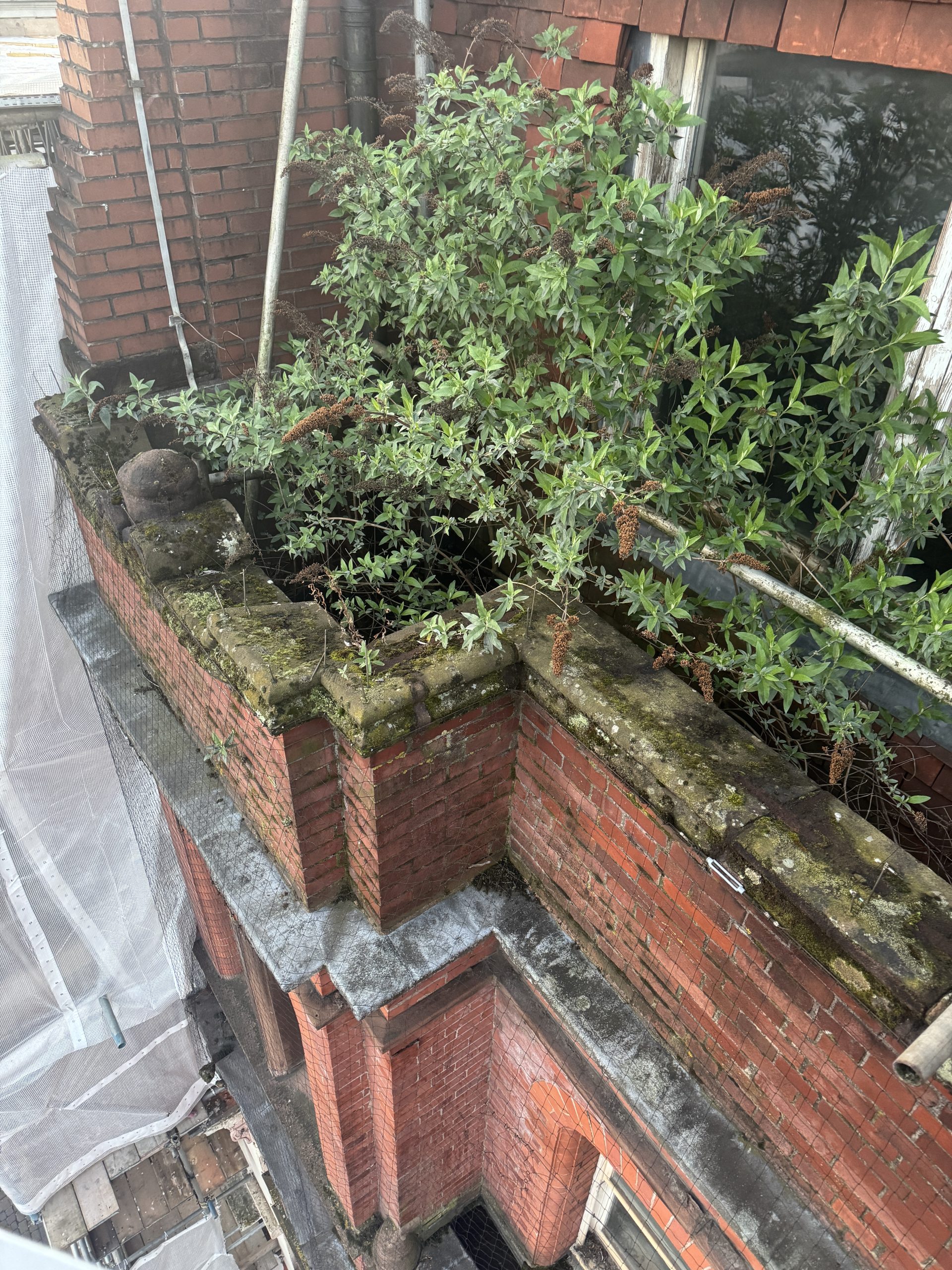
Elsewhere, gutters and drainage channels were blocked or defective, particularly beside the eastern pitched roof and within the western flat-roof area. Rooted plants were growing from parapets and other high-level masonry, while standing water and debris were present across vulnerable horizontal surfaces.

These maintenance defects had created the conditions for continued water penetration, salt activity, biological growth and freeze-thaw deterioration. They also demonstrated the importance of considering the façade, roof coverings and rainwater disposal system as interconnected parts of the same building envelope.

Market Street, Manchester

The survey recorded several areas where loose or friable sandstone presented a continuing risk of detachment above the public highway. In at least two locations, netting was helping to retain unstable masonry, but this could not be regarded as a permanent solution.

We recommended that scaffolding be erected to allow all high-level elements to be inspected closely and made safe as a priority. Targeted opening-up should be undertaken to assess the condition of embedded iron cramps and dowels, which may have corroded and expanded within the stone. Where necessary, these should be removed or isolated and replaced with stainless-steel fixings.

Depending on the condition of each element, repairs may include stainless-steel pinning, compatible mortar repairs, indent repairs or the replacement of severely deteriorated stone. Particular attention should be given to the eastern balconies, projecting cornices and string courses.

The masonry also exhibited localised cracking, including stepped cracking within the upper brickwork. A structural engineer should determine whether this movement is historic or active and direct any necessary stitching, grouting or sympathetic reinforcement. Early installation of tell-tale monitors would provide useful evidence before the main repair programme begins.

Repairs should retain as much historic material as possible and preserve the façade’s established character. Existing patina need not be removed simply to create a uniformly new appearance. Where cleaning is required to treat heavy soiling or salt deposits, a low-pressure, non-abrasive system should be trialled first, potentially supplemented by a specialist gel or poultice suitable for porous historic masonry. High-pressure washing, abrasive techniques and harsh chemicals should be avoided.

Compatible repair materials, carefully matched stone and brick, lime-based mortars and discreet stainless-steel reinforcement will allow the building to retain its architectural interest while reducing the risks associated with loose masonry and continuing water ingress.

Most importantly, the repairs should be supported by a planned maintenance regime. Regular inspection and clearance of rainwater goods—recommended on a three-monthly basis—will help keep parapets, balconies and projecting masonry dry. This relatively simple intervention will be fundamental to slowing future decay and protecting the renewed façade over the long term.

Context and materials – Managing moisture in Manchester’s historic masonry

Although 90–100 Market Street is not nationally or locally listed, it occupies an important position within the Upper King Street Conservation Area. Its richly modelled commercial frontage contributes to the historic character of central Manchester and reflects the materials and architectural ambitions of the late nineteenth and early twentieth centuries.

The contrast between the two sections of the building was central to understanding their differing patterns of deterioration. The eastern façade combines mass-produced red brick with extensive red-brown sandstone dressings, likely comparable to locally sourced Collyhurst-type stone. This creates a lively and decorative composition, but the projecting balconies, cornices, string courses and window details also provide numerous horizontal surfaces on which water can collect.

The western façade is constructed principally from smoothly finished ashlar sandstone. It contains fewer projecting features and was therefore found to be in better overall condition. Nevertheless, localised erosion, failed pointing, biological growth and inappropriate previous repairs showed that it remained vulnerable where maintenance had been limited.

Historic sandstone of this type is comparatively soft and porous. When gutters become blocked, coping joints fail or balcony outlets cease to function, the stone absorbs prolonged moisture. Repeated wetting and drying, salt crystallisation and freeze-thaw action can then cause its surface to blister, delaminate and eventually detach. Corroding embedded ironwork may compound the damage by expanding and forcing the surrounding stone apart.

The repair strategy therefore addresses both the visible defects and their underlying causes. Replacing damaged masonry without improving drainage would offer only a temporary solution. Equally, introducing hard cement mortars or impermeable coatings could trap moisture and accelerate deterioration within the original fabric.

Other projects

Get in touch with us today